
4 ways to feel so you can heal

When people come to see me about the difficulties in their lives I teach them to be more aware of their own thoughts, emotions, reactions and body sensations that occur when they encounter difficulties.

There is a reason for this.

Many years ago, John Bradshaw wrote that you cannot heal what you cannot feel.

Many have sought to debunk this statement, but the reality is that pushing the difficult feelings down so you think you aren’t aware of feeling them, does not allow healing.

The difficult feelings are still there, even when you can’t consciously feel them. And those difficult feelings have a massive impact on your behaviour and reaction to things.

DO YOU WANT TO BE FREE OF THESE REACTIONS TO THINGS THAT YOU CAN’T CONTROL?

Here is what I teach you to do. It is based on the RAIN meditation as taught by Tara Brach.

  1. Recognise or become aware of your emotions. This includes being aware of what is happening in your body. a. What sensations can you feel? b. Where do you feel them? c. What do they feel like? d. What are the thoughts in your mind?
  2. Acknowledge and name what you are feeling. This is important as you cannot address the emotions if you aren’t able to identify them. Also, naming your emotions helps you to separate them from you personally.
  3. Investigate or explore those feelings. This is important to understand where they come from. It is helpful to consider how old the one expressing the thoughts is. Reactions to things come from past events when a difficult incident has become embedded unresolved in your memory. When incidents occur that are similar to the original incident you react according to that unresolved memory.
  4. Nurture yourself. Offer yourself compassion and kind words of comfort.

Let me share this in a more expanded form.

PROTEST OR TRANSFORM?

Becoming aware of your emotions is important. So often you may feel upset, uncomfortable, angry and not know why. Your rational brain may be telling yourself you are being silly. You may feel alarm because in the past these feelings have led you to behave in ways that have damaged relationships.

I have been taught that when I face difficulties in life there are two choices:

• Protest and push through

• Transform and stop to explore what I am feeling.

Protesting means you just push forward and push the emotions down. You may react in ways you wish you hadn’t. You just push forward and keep going. And this situation repeats and repeats until you do something to get help.

RAIN

Transforming means you stop. You allow yourself time to explore what is happening for you.

You follow the path of RAIN.

RECOGNISE WHAT YOU ARE FEELING

You seek to become aware of what you are feeling. You become aware of the sensations in your body, their location, the type of sensation they are, the words or phrases running through your mind. All these are valuable for you to understand what is happening.

If you take the time, you will realise what you are actually feeling.

Don’t be afraid of those feelings. All feelings are okay. They are vital clues to what is happening for you. They are clues to unresolved issues from the past. Issues that continue to influence the way you react to things.

ACKNOWLEDGE YOUR FEELINGS

Now you have taken the time to identify your feelings you can name them.

This naming is not a shameful or condemning thing to do. It is about recognising without judgement that perfectly understandable feelings you are experiencing.

You may be feeling angry, hurt, confused, shame, fear and so on.

INVESTIGATE YOUR FEELINGS

You have named your feelings, now you are going to investigate them further.

• Where did those feelings come from?

• Are there any memories that come to mind when you investigate those feelings?

• What do those phrases in your head say?

You have found a memory – now it is time to go deeper and explore more of that memory.

• How old were you?

• What was happening for you?

• What were you feeling then?

• Is it reasonable to judge yourself at that age, circumstance?

AN EXPLORATION INTO THE PAST

Often when you explore the source of feelings you find their source is an incident from your childhood.

Looking back now you can realise the child’s feelings and experience were normal for a child of that age and developmental stage. You can see the child you were as a small child who needed support and understanding. You can see that you can’t judge them from an adult perspective, because they were a child. You can recognise that the thoughts the child had are based on the child’s limited understanding of the world. As an adult you can give a different interpretation to the situation and not judge the child for what happened.

NOW YOU UNDERSTAND YOU CAN COMFORT

The natural thing to do now is the offer comfort to that small child. You are the adult looking back at an incident in your childhood. You can recognise that truth of the situation and that the child needed an adult to offer support and love.

You are the adult. It is time for you to comfort the child.

So offer them words of love and support.

“My darling that was so scary.”

“you were so confused.”

“it’s okay now. I am here. I’ve got this.”

THERE ARE MANY WAYS YOU CAN CALM YOURSELF

Comforting yourself as I described above is a really great way to calm yourself.

Mediation can really help to. Guided ones are great ways to start.

Learning Mindfulness is important to help you be able to recognise what is going on in your body. You can also meditate using Mindfulness. At the end of this post I have a link to sign up for my newsletter. Signing up gives you access to a quick mindfulness meditation you may like to try.

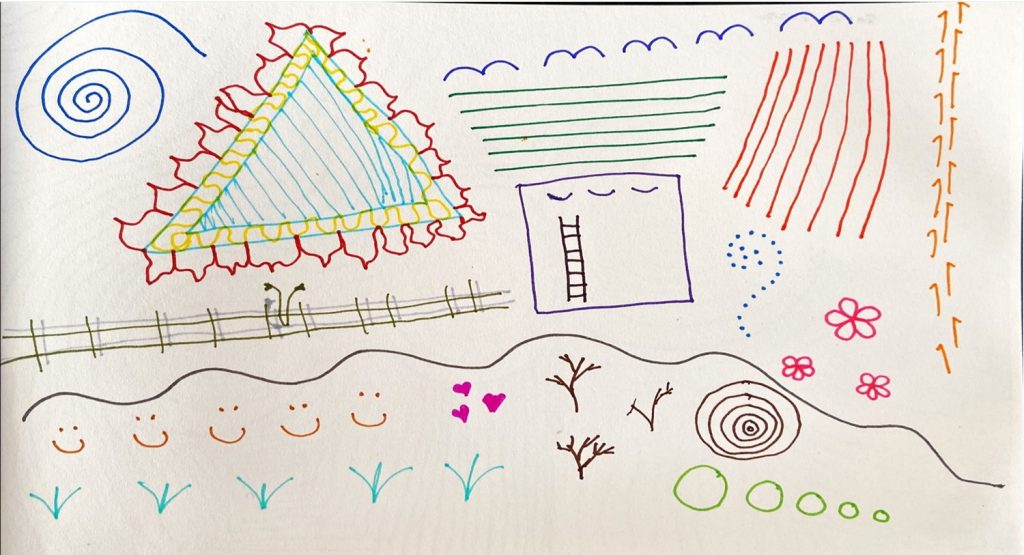
You can also try painting. I don’t mean painting some masterpiece. I just mean putting your feelings on to paper. You can swirl paint around. You can paint lines, dots, circles, squiggles, cover the page with paint, mix it all together into a muddy clump. You can use your fingers. Just allow yourself to put on the page what you need to let go of. Remember, if you feel like painting figures, stick figures are fantastic.

Journalling can be another outlet as well.

EXERCISE AND FUN ARE IMPORTANT TOO

You may find taking a walk calming, especially if you walk amongst the trees or on a beach.

Swimming, any form of exercise, yoga, stretches. There are myriad ways you can move.

Remember the importance of just having fun. Laughing with friends or family, throwing a ball around, trying to ride a unicycle!, anything that is fun. Just being able to forget your worries and responsibilities and have fun with others.

WATCHING YOUR DIET

Making sure you eat foods low in sugar is important. As is avoiding too many take aways. Add lots of vegetables into your diet. The healthier your diet, the better you feel.

Restricting sugary drinks and not drinking excessive amounts of alcohol are also helpful.

When your body is trying to cope with excess amount of sugar, too much alcohol for your liver to comfortably process and foods that your body struggles to process and dispose of the waste from, you will not feel well.

Increasingly research is demonstrating a link between your bowel and your brain. The quality of your diet has a massive impact on how you are feeling emotionally.

HOW COUNSELLING CAN HELP

When things in your life have been overwhelming and leave you struggling, it can be hard to recover without specialised help.

Seeing a counsellor specialised in treating these difficulties, which are all referred to as trauma, is important. Do check that the person you want to see is trained in treating trauma. You can’t just repeat sentences every day and hope the trauma can go away.

You don’t have faulty schemas in your head that need correcting. You have painful memories that need to be allowed to be expressed and healed. This does not mean you have to revisit painful memories, just that you need to be able to access the memories stored in your body and release them.

A properly trained counsellor can help you to learn how to calm yourself and feel safe.

When you are able to feel safe you can then learn how to safely heal those difficult memories.

BLUE KNOT FOUNDATION

The Blue Knot Foundation in Australia is the peak body on childhood trauma and runs training for mental health practitioners. Their training and the practice guidelines they have written are internationally renowned.

I have completed many years of Blue Knot Training and follow their practice guidelines in my work.

CAN I HELP?

If you would like to talk to me about how I can help you with your trauma, please contact me on 0409396608 or nan@plentifullifecounselling.com.au

If you would like to learn more, I write a regular newsletter with interesting information, tips, information on courses, and the occasional freebie. At the moment I have a free mindfulness meditation for anyone who signs up to my newsletter. This meditation offers a way to safely explore your feelings and learn to be okay with them. If you would like to subscribe please click on the link here: http://eepurl.com/g8Jpiz

3 Steps to Transform Life’s Problems

One of the biggest problems encountered in life is the things that happen to interrupt the smooth path through life.

The job you don’t get, the “no” you get when you want to do something really important to you, the friend you fall out with, the family member who hurts you.

All these things, and more, can really upset your equilibrium.

WHEN PROBLEMS HAPPEN IN LIFE TO BLOCK YOU

The reaction that usually happens is to be upset and to protest.

Protest is something that is seen all the time.

The person who acts out with road rage, the person who gets angry at delays in a queue, your upset and howls of protest when something happens to you.

It is natural when something happens to block your forward progression in life to protest, to push against what has happened. Then to keep going forward in the same direction.

But that is not always helpful.

And it does not resolve the hurt at what has happened.

THERE ARE TWO CHOICES WITH LIFE’S BLOCKAGES

When obstructions come, there are two choices. It may not seem that way, because you most likely saw others use only one way, were taught only one way, when you were growing up.

You can protest, sure.

But you can also transform the situation.

WHAT HAPPENS WHEN YOU PROTEST

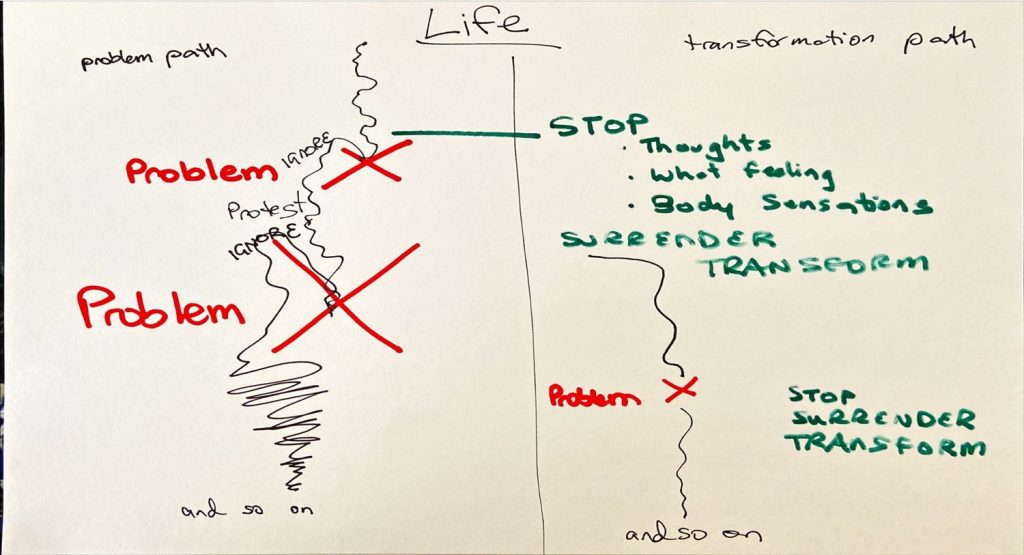
If you protest you push back against the situation. Then you ignore it and keep going on the same path.

And you carry the hurt and anger at the obstruction. It rankles and the situation is rarely resolved satisfactorily.

And next time you protest even more.

It is hard if you have had a lot of hurt in your life. Unfair things happening in your childhood. Hurts that were never acknowledged.

It all hurts.

And you protest and want something better.

AN EXPERIMENT TO TRY

I want you to try something now.

I want you to put your hands together and push them hard together. Take your time. Push hard and spend time observing what sensations you are noticing in your body.

What does it feel like in your body?

Now push hard against the wall. Again take your time. Push hard. Spend time observing the sensations in your body.

What does that feel like in your body?

Now stop.

NOW TRY ANOTHER EXPERIMENT

I want you to reach out for something that is just beyond your reach, so you have to reach, really stretch yourself out.

Take your time. Reach, stretch out. Spend time observing the sensations in your body.

What does that feel like in your body?

WHAT EXPERIMENTERS REPORT EXPERIENCING

Most people will report that pushing against their hands or the wall feels like they are closing in on themself. Shutting themselves off.

Most people will then report that reaching out to grab something just out of reach feels like opening up.

WHAT PROTEST FEELS LIKE

Pushing your hands together or the wall away from you is what happens when you protest.

It closes you up. Restricts you. Feels awful.

WHAT THE ALTERNATIVE FEELS LIKE

Reaching out is what happens when you seek transformation.

It opens you up. Feels freeing. Opens your mind to possibilities.

TWO CHOICES

When a problem presents itself you can choose to protest. To feel the unfairness of what is happening. To fight it. To close yourself up and push through.

Or you can choose to stop and explore what is happening for you inside.

What thoughts are you experiencing?

What emotions are you feeling?

What sensations can you notice in your body?

Those three questions will help you to truly explore what is happening.

WHAT IS THE PROTEST REALLY ABOUT?

You may be surprised at the experience.

Some people have told me that when they explore their thoughts, feelings and body sensations they are surprised to observe they are feeling relief.

Others observe pain, but find that if they are curious and stop fighting the feelings they can find a solution. This does not necessarily resolve the problem, but it does allow them to discover a way to transform the situation.

Others realise the anger they feel is not about the current situation but something that happened in childhood

WHAT IS THE ALTERNATIVE TO PROTEST?

What is the alternative when you want to protest?

It is so surrender to these feelings. It is to reach out and feel the opening up of your body and mind. It allows you to transform the situation into something that you can grow from. It allows you to understand the past hurts that impact on the current situation and maybe be able to untangle some of that old pain.

It also reduces your pain. Once you surrender to something, although it may still hurt, it will hurt less then if you protest and remain closed.

THE 3 STEPS

So the next time you encounter a difficulty in life, choose transformation. In order to transform the situation try this:

  1. Stop and allow yourself to just be with what has happened.
  2. Allow yourself to explore what you are thinking, feeling, and the sensations in your body. Address the thoughts that come up. Allow yourself compassion when old hurts are uncovered. You may find yourself surprised at the emotions you are feeling. You may recognise some of those body sensations again. They are vital clues to warn your when things are getting overwhelming and you may need time to calm yourself.
  3. Surrender to what is happening. Reach out to it. Pull towards it. Allow yourself to be open to new possibilities.

You won’t always be able to do this. There are times when things are so disruptive you need recovery time, but it will allow you to process many things. And with practice, you will be able to transform more and more disruptive things.

NEED HELP?

If you would like to talk to me about how I can help you transform the big problems in your life, please contact me on 0409396608 or nan@plentifullifecounselling.com.au

If you would like to learn more, I write a regular newsletter with interesting information, tips, information on courses, and the occasional freebie. At the moment I have a free mindfulness meditation for anyone who signs up to my newsletter. This meditation offers a way to safely explore your feelings and learn to be okay with them. If you would like to subscribe please click on the link here: http://eepurl.com/g8Jpiz

9 Steps to Managing Conversations at the Dreaded Family Christmas

Families are never completely harmonious. They are comprised of people, bound together by genetic and marital ties, who often are not free to discuss conflicts as openly as is healthy. There are often undercurrents of tension and unresolved hurts in any family interactions.

Add a family Christmas, with all the stresses that “perfect” day brings. Add to the mix some freeing alcohol. Add to the mix the proximity with people who have caused those tensions and unresolved hurts.

Mix these ingredients and you have an explosive mix.

You can try to avoid difficult topics, but inevitably something will come up, particularly if you have the mix listed above.

Below are 8 steps you can use to survive the family Christmas. 8 steps to help you keep away from the difficult topics you may not be ready to discuss in a large family gathering.

  1. PREPARE FOR THE DAY.

Are you expecting challenging topics of conversation? Plan in advance how to manage and deescalate these potential ignition points.
a) PLAN TO SET BOUNDARIES

You can set boundaries by letting family members know what areas are contentious and that you want avoided. You can practice how you will set this boundary in a positive, affirming way.

Maybe you might say something like: “I love seeing you and our time together is really great. There are just some things that we disagree on and maybe we can avoid discussing them today so that we can enjoy our time together.”

b) PREPARE AHEAD

Before you meet up, think about happy things you and this family member/s have in common. Are there happy childhood memories you can share, do you have the same interests? Brainstorm ideas of topics of conversation so you are ready to have a conversation. When you have no topic to discuss, conversations tend to follow well worn paths. If those well worn paths are the contentious ones, then that is what you are going to end up having a conversation about.

  1. REDIRECT THE CONVERSATION.

Preparing ahead safe topics to discuss will allow you to quickly redirect the conversation to a safer topic that is related to the contentious topic. It is easier to pivot if the topic is related somehow, so if someone brings up a humiliating episode when you were a child and were swimming, you may bring in a conversation about wonderful beaches to visit and direct people to that topic. In that situation, the chances are that others in the conversation are not happy to bring up the humiliating episode either and will welcome the change to change the topic.

  1. REHEARSE WHAT YOU ARE GOING TO SAY.

When you are under stress, you will tend to do what is habitual. So well used responses to others will tend to be used. This will quickly derail your intention to steer away from the uncomfortable conversations. So practise what you will say. Have imaginary conversations where the other person says something they usually say, or makes a comment about a situation they usually comment on. Imagine redirecting the conversation away from that contentious comment and what you will say. While you are doing this, imagine being relaxed and able to deflect any triggers in their words. Imagine calmly setting a boundary, or redirecting the conversation, or making a statement.

While you are imagining this conversation, practice taking calming breaths and imagine you are releasing all the tension and it is flying away as you breathe out. As you breathe in, imagine you are breathing in peace and calm.

If you have a family member who makes highly politicised comments, or makes racist comments, or expresses strong extremist viewpoints, practice a statement that acknowledges their opinion but indicates it is not up for discussion. The well tried response to this is to “agree to disagree” and have no more conversation around that.

Sometimes these statements are deliberate attempts to bait you into responding. Don’t. Set the boundary and try to change the topic of conversation. If the person still persists, walk away. Take a walk around the block if you need to calm down. Just remain calm until you are somewhere where it is safe for you to be upset. More on that later.

  1. BRING OUT THE OLD HAPPY MEMORIES.

This is another redirecting technique. Bringing out a positive family story involving a happy memory. The more family members involved in this memory the better. If you start off saying “Remember when xxx” you are inviting others to add their recollections of the memory. Not only is that fun to share in happy reminiscences, it also shuts down anyone negative due to the weight of people participating in a new conversation.

Remember, a family member who is difficult for you to get along with, may also be difficult for others to get along with. Other family members may welcome your efforts to redirect the conversation and be more than happy to jump in with enthusiasm. After all, everyone wants to have a lovely day.

  1. FOCUS ON FUN FAMILY TRADITIONS.

There will no doubt be things your family enjoy doing together on family occasions. There are families that love to gather around the piano and sing Christmas carols. Others love to play games. Others have a post Christmas lunch walk.

If your family has traditions then make sure they are carried out. If they don’t have any, then introduce some new things you think family members will be interested in. Prepare the ground for this. Talk about this “fun” idea with family members you think will be useful allies in this so that when you introduce the idea it will be supported by other people. These traditions are a great way to distract from unpleasant conversations.

  1. PRACTICE GRATITUDE.

In the lead up to Christmas, think of at least 10 things to be grateful for each day. Write them down and say them out loud, followed by three thank yous. Slowly introduce gratitudes for family members.

Don’t force the jolliness. Find things you are genuinely grateful for. They may range from extraordinary things to the seemingly mundane such as your health, your home, your job and so on.

Each day add gratitudes for family members. Start with the ones you love seeing. As you get close to Christmas think about the ones that cause you grief. Is there anything about them you like? Anything about them you admire? Try to find something to be grateful for about them. One might be that they are diligent about attending the family Christmas every year. Another might be they help with the washing up. Another might be they love their car. Find something to be grateful for.

Finding positives help you to feel more empowered and more in control of those difficult situations. It also helps to see the main protagonists as people with less power than you thought they had.

  1. FIND ALLIES.

Think about who will be at the Christmas event and identify those you find supportive. They may be the type who will speak up and support you at the time of the difficulty, or they may be someone you can speak to later to help you calm down.

It is easier to manage in stressful situations when you know you have support.

  1. PRACTICE CALMING TECHNIQUES.

One of the easiest ways to calm down is breathing. It is best to practice this technique in advance so that it is second nature when you need it. If you try this for the first time when you need it, it is unlikely to work effectively.

a) MINDFUL BREATHING

The best way to practice is to start small.

• Set a reminder on your phone for every hour if possible.

• Now prepare to breathe for 1 minute.

• Set a timer for 1 minute.

• Sit quietly with your hands resting in your lap.

• You may choose to let your focus slip or you may choose to close your eyes.

• Now breathe in while noticing the feeling of the air entering your nose and your chest and tummy rising with the in breath.

• Now breathe out while notice the feeling of your chest and tummy falling and the feeling of the air passing through your nose.

• With the next in breath, imagine you are inhaling calming air. Imagine it is a beautiful calming colour such as blue or green, whatever your find calming. See that coloured air entering your nose and lungs.

• Now breathe out all the tension and difficult emotions. Imagine the air you breathe out is the colour of tension and difficult emotions such as red, whatever you find expresses what you are feeling.

• Continue breathing in calm and breathing out tension. You can say to yourself I am breathing in calm on the in breath. And you can say I am breathing out tension/anger (name emotion) on the out breath.

• If you notice your mind wander away from noticing your breath just return your attention to your breath without judging yourself.

• Continue until 1 minute is up. Notice how you are feeling calmer and more in control of your emotions.

If you practice your 1 minute mediation as often as you can you may consider the next day practising for 5 minutes sometimes and 1 minute at others.

Practice as often as you can. When you need this calming at the Christmas event you will find it easier to slip into the practice if you have taken the time to practice in advance.

You can use mindful breathing sitting or moving around. Many people practice as they are walking. This is something you might try if you need to get some space away from the difficult people.

b) RELEASING WALK

The walk works like this:

• Don’t rush to push the emotions you feel away. Allow yourself to feel them, name them and walk them out. Stamp if you need to, walk fast if you need to. Swing your arms around. Whatever allows you to release what you are feeling.

• Once you have allowed yourself that time and you have acknowledged and released the emotions you can then walk at a calmer pace at your speed.

• Notice what is around you. What can you see, hear, smell, touch or taste?

• Take a deep in breath. Notice the sensation of that breath entering your body as you walk.

• Release that breath and notice the sensation of it leaving your body as you walk.

• Continue breathing and paying attention to your breath.

• Remember to breathe in calm and breathe out stress, anger and/or other distressing emotions you are experiencing.

• As you notice yourself feeling calmer, you can start paying attention to the beauty around you.

• Remember to just return your attention to your breath if your mind starts to wander.

• As you settle into this calming routine, allow yourself to feel your feet on the ground. Feel the ground supporting you are you walk.

• Allow yourself to feel the air around you. Feel the air wrapping you in its loving embrace.

• Continue walking, feeling the calm and feeling the support that surrounds you.

• When you are ready you can return to the gathering.

• You may decide to stay there, you may decide to communicate boundaries, you may decide to leave. Do whatever feels right for you.

  1. MAKE OTHER ARRANGEMENTS

If you feel that it is too distressing to attend the family Christmas, make other arrangements.

Maybe you would like to attend a community lunch.

Maybe you know other people who are on their own at Christmas. Perhaps you can get together to celebrate.

Maybe you would like the day alone with some lovely food and a stack of movies/games/books you would love to watch.

You may even find other family members don’t like the event and would be happy to do something with you instead.

A FINAL WORD

You have prepared yourself for the family Christmas and it is still difficult. Be okay with that. Don’t forget your strategies. Set realistic expectations of how people will be and prepare for this.

Do take the time to take some calming breaths before responding to other people. It can help to name what you are feeling. This allows you to cope better. It also allows you space to decide to not react to this person. It is in this moment you may choose to walk away, or calmly say their comment is inappropriate, or not funny, or unacceptable or anything else.

People can get to you with their behaviour and comments because you have unresolved hurts. After Christmas, review the family Christmas. What came up for you? Is there something you need to resolve. Counselling can be really helpful to explore and resolve old hurts. You can also learn helpful strategies to cope.

WHERE TO GET HELP

If you would like to talk to me about how I can help you with your unresolved hurts, please contact me on 0409396608 or nan@plentifullifecounselling.com.au

If you would like to learn more, I write a regular newsletter with interesting information, tips, information on courses, and the occasional freebie. At the moment I have a free mindfulness meditation for anyone who signs up to my newsletter. This meditation offers a way to safely explore your feelings and learn to be okay with them. If you would like to subscribe please click on the link here: http://eepurl.com/g8Jpiz

PLEASE NOTE PLENTIFUL LIFE COUNSELLING WILL BE CLOSED FROM 5PM 21 DECEMBER 2022 AND WILL RE OPEN AT 9AM ON 9 JANUARY 2023.

How to set healthy boundaries at family Christmas get togethers

We all know the pressure to have the perfect Christmas. There is also the pressure to buy presents, to prepare food, to clean the house if you are hosting anyone for Christmas, or to travel away from home with all its associated stress if you are visiting for Christmas.

It is well accepted that Christmas can be a stressful time.

It is also accepted that getting together with family can be stressful as well.

Another stressful aspect of Christmas is the sheer volume of Christmas parties you may be invited to. You may receive more invitations than you feel comfortable accepting, yet you do accept them because you don’t want to let anyone down, or disappoint them.

All this stress can be overwhelming and make Christmas a less than enjoyable time for you.

Many people learn early in life to please other people. Maybe you are a people pleaser.

You may have learned to do this in your childhood home. It may have been a matter of survival. You may have learned to do this to make friends at school, or protect yourself from bullies. You may have learned to do it due to being in an abusive relationship. You may have learned to do it because you didn’t believe people would like you if you said no.

Whatever the reason, it can be a problem at Christmas.

It can be a problem when you feel you have to accept every invitation to attend a Christmas Party, even when you feel overwhelmed with busyness.

It can be a problem when you see family members at Christmas and you fear the expectations they have that you will go alone with anything they suggest.

Of course, you won’t only be a people pleaser at Christmas. It is just that it seems to be a time when you are called on more to people please and your stress levels are already high.

What do you do about it?

It is worthwhile considering how much of a problem this is.

To determine the extent of the problem it is helpful to understand the impact people pleasing can have on you.

• It can increase your stress

• It can lead to you feeling depressed

• You can feel resentful

• You can feel angry

• You can push yourself to the point of exhaustion which can impact your physical health

• It can lead to you now enjoying Christmas time at all

• It can cause you to neglect your self care

• It can harm your relationships

SO WHAT DO YOU DO ABOUT IT?

We all say yes to things on occasion that we may not want to do. That is a choice we make in accommodating other people.

But if you say yes all the time, even when you don’t want to, then you do need to do something about it.

People pleasing, or fawning, is a stress response. It is part of the responses our brain activates when we are in danger.

The most well know of those responses are Fight and Flight. People pleasing, or fawning, is part of this group of defence mechanisms. When you fawn, you seek to accommodate the needs of others to the point where you don’t meet your own needs.

You may find you are not able to tell others how you really feel about something.

You may put the needs of others ahead of your own. A good example of that is saying yes to a Christmas party invitation when you are exhausted and really need to rest.

You may say yes to every request made of you.

You may seek to flatter others.

You may have low self esteem.

You will probably go to great lengths to avoid conflict

You may feel you are taken advantage of and that may really irritate you.

You may worry about fitting in with others and be frightened of having an argument with another person.

THE HIDDEN COSTS OF BEING A PEOPLE PLEASER

Because you always put your needs last, you are more vulnerable to emotional abuse and being exploited by others. You are also more vulnerable to abusive relationships.

At Christmas, being a people pleaser can lead to high levels of stress and you finding this time of year anything but relaxing.

SOME BANDAID MEASURES TO TRY

Feeling safe enough not to people please is a slow process. There are some things you can try in the interim. How effective they are will depend on how safe you feel, but you will only know when you try.

It is helpful to enlist the support of someone else who can be there and give you encouragement, give you some time out and be a listening ear when you need it.

THIS IS IMPORTANT TO KNOW

You need to know these important things:

• You deserve to be able to do what you want

• You deserve to be here and to take up space

• You are enough, just as you are

• Your thoughts, feelings, opinions and boundaries matter

• Most of the time when you say no you will survive.

WHAT DO YOU MEAN “MOST OF THE TIME”?

I would never recommend you stand up to a violent abuser or a coercive controller. That is dangerous. If you are in those situations it is best to contact 1800 RESPECT for assistance.

Apart from that it is okay to say no.

WHAT ARE THE BANDAID MEASURES?

The main measures to take are to be able to say “no”.

Your friend asks you to come to her party. You don’t want to go. You are worried about disappointing her by saying no.

STOP

You deserve to be able to do what you want.

You take a deep breath and say “no, I can’t come”. You may like to add a thankyou for your invitation.

It is important to remember that you don’t have to explain why you are saying no. Your no is no and that is good enough.

ANOTHER EXAMPLE

You arrive at your Aunt’s house for the extended family get together. She is a very organised and determined woman, used to give you orders and expecting you to jump to obey them.

You have drive 2 hours through heavy traffic to get there and you are tired, frazzled and need to destress for a while.

She jumps in with an order to prepare something in the kitchen. I might add at this point that everyone has brought food to contribute to the family feast so there is nothing to prepare in the kitchen.

You don’t want to. You need to sit for a while and see the rest of the family.

You have enlisted your partner to support you.

You say “no”. it is probably a good idea to add “when it is time to put the food out I can help you for a short while”.

She may be stunned you said no. She may try to shame you into helping. She may want to argue. If you can , walk away. If need be you may need to tell her that you need to destress after the drive and want to catch up with family members. You may ask if she has caught up with family members and suggest you can do that together.

Your partner can also support you by steering you away from your aunt, or, if necessary, stepping in to enforce the boundary.

HOW DO I LEARN TO SET BOUNDARIES

I have already mentioned that people pleasing is a survival response. It is learned because of traumatic situations.

When you have trauma in your past, you often find it hard to feel safe and manage your emotions, which are often very strong. You will frequently feel unsafe and that is something that you can heal from slowly with the correct treatment.

In Australia the Blue Knot Foundation has well respected trauma treatment guidelines that are effective in healing. It is wise to seek out a therapist who adheres to these guidelines.

WHERE CAN I FIND A THERAPIST?

If you would like to talk to me about how I can help you with your people pleasing, please contact me on 0409396608 or nan@plentifullifecounselling.com.au

If you would like to learn more, I write a regular newsletter with interesting information, tips, information on courses, and the occasional freebie. At the moment I have a free mindfulness meditation for anyone who signs up to my newsletter. This meditation offers a way to safely explore your feelings and learn to be okay with them. If you would like to subscribe please click on the link here: http://eepurl.com/g8Jpiz

6 ways to gain control of your mind with overwhelming emotions or anxiety

You know how it is.

There are those times in life when you get so anxious you can’t think straight and find yourself saying and doing things that you wish you hadn’t.

Or there are those times when you are overwhelmed by intense emotions and can’t function, or worse still react in a way you don’t want to.

What do you do?

In the long term, counselling to find the root cause of the problems and defuse them is great.

But what do you do in the short term?

Learn how to identify the signs you are getting anxious or your emotions are intensifying. You need to be able to identify them before they get out of control.

When you feel those early signs practice grounding to help you gain control of them.

6 ways to practice grounding are:

  1. Tune into your Body. Feel your feet on the ground. Pressing your toes into the floor will help make that connection. Look at your shoes. What size are they? What do they look like?
  2. Engage your senses. put on a favourite shirt, smell essential oils, make yourself a warm drink, go outside and feel the wind on your body or gaze at a tree or clouds.
  3. Self-soothe. find an object connects you to something solid outside yourself. This may be a rock, a soft toy, a tree to hug. You might find taking a shower or a bath helps.
  4. Observe. look around you. What can you see? Choose an object and describe it in detail. What colour is it? What is its texture? What about the play of shadow and light in the object? What shape is it?
  5. Breathe deep to the bottom of your chest. Practice 4-7-8 breathing. Breathe in for 4, hold for 7 then breathe out through pursed lips for 8. This is a wonderful way of engaging your Polyvagal Nerve and calming yourself.
  6. Distract yourself. Look around the room. Find all the red objects. Find all the objects with right angles. Count backwards from 100 by 5s. Anything that focuses your attention somewhere else.

Everyone has moments when it is hard to maintain control over intense emotions or anxiety. If you learn how to spot those moments and stop them before they are out of control then you are on the path to having more control over your life.

If you would like to talk to me about how I can help you with the long term healing of your anxiety and overwhelming emotions, please contact me on 0409396608 or nan@plentifullifecounselling.com.au

If you would like to learn more, I write a regular newsletter with interesting information, tips, information on courses, and the occasional freebie. At the moment I have a free mindfulness meditation for anyone who signs up to my newsletter. This meditation offers a way to safely explore your feelings and learn to be okay with them. If you would like to subscribe please click on the link here: http://eepurl.com/g8Jpiz